Chapter 5: Laplace Transforms notes, Kohler & Johnson 2e

Author

Chalmeta

5.1 Introduction to Laplace Transforms

The Laplace Transform

When we are looking at problems involving Laplace Transforms there are always 2 domains to which you need to pay attention:

  1. The time domain: variable (\(t\))
  2. The transform domain: variable (\(s\))

When you work problems you must be either entirely in the time domain or the transform domain. As a general rule you DO NOT work in both domains at the same time.

This flow chart shows the two different ways to solve a differential equation. You can either take the direct route or you can take the Laplace Transform route.
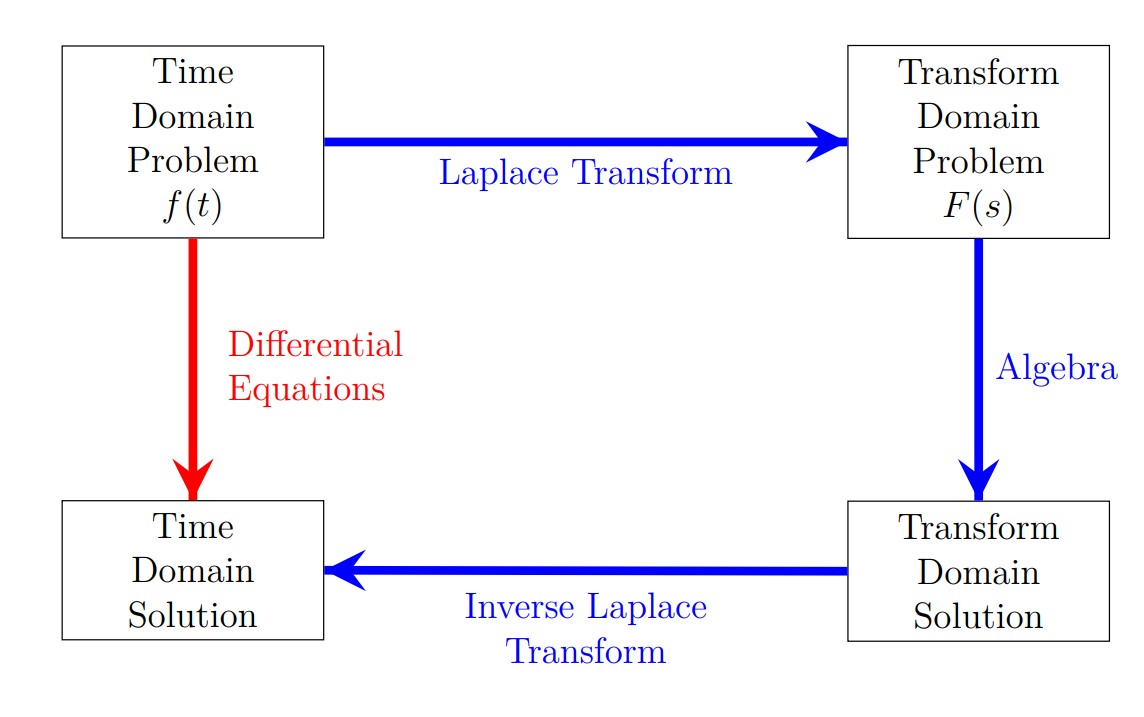
Laplace Transform flowchart showing the relationship between time and transform domains. The diagram has four boxes arranged in a square pattern. Top left: Time Domain Problem f(t). Top right: Transform Domain Problem F(s). Bottom left: Time Domain Solution. Bottom right: Transform Domain Solution. A blue horizontal arrow labeled Laplace Transform connects the top boxes from left to right. A red vertical arrow labeled Differential Equations connects the top left to bottom left boxes. A blue vertical arrow labeled Algebra connects the top right to bottom right boxes. A blue horizontal arrow labeled Inverse Laplace Transform connects the bottom boxes from right to left. This illustrates that you can solve differential equations either directly in the time domain (red path) or by transforming to the s-domain, solving algebraically, then transforming back (blue path around the diagram).

All Laplace transform problems have 3 steps:

  1. Laplace transform to make the problem algebraic (simpler).
  2. Solve/simplify the transformed problem with algebra.
  3. Inverse Laplace transform to find solution.
NoteDefinition of Laplace Transform

Definition: Let \(f(t)\) be defined for \(t\ge0\) and let \(s\) be a real number. Then the Laplace transform of \(f(t)\), denoted \(\mathcal{L}\{f(t)\}\), is the function \(F(s)\) defined by:

\[\mathcal{L}\{f(t)\}=F(s)=\int_0^\infty e^{-st} f(t)\,dt \tag{5.1}\]

for those values of \(s\) for which the improper integral converges.

TipExample 5.1.1

Find the Laplace transform of \(f(t) = 8\)

Solution: Recall the definition of an improper integral. If \(g\) is integrable over the interval \([a,T]\) for every \(T>a\), then the improper integral of \(g\) over \([a,\infty)\) is defined as:

\[\int^\infty_a g(t)\,dt=\lim_{T\to\infty}\int^T_a g(t)\,dt \tag{5.2}\]

We say that the improper integral converges if the limit in (5.2) exists; otherwise, we say that the improper integral diverges or does not exist. So when we integrate for a Laplace transform we use the limit definition of the improper integral.

\[\begin{align*} \mathcal{L} \{8 \} & = \int_0^\infty 8 e^{-st} dt\\ & = \lim_{T \rightarrow \infty} \left( \frac{-1}{s} \right) \left[ 8e^{-st} \right]_0^T\\ & = \lim_{T \rightarrow \infty} \left( \frac{-1}{s} \right) \left[ 8e^{-sT} - 8 \right]\\ & = \begin{cases} \frac{8}{s} & \text{for } s>0 \\ \infty & \text{for } s<0 \end{cases} \end{align*}\]

Notice that if \(s<0\) then \(e^{-sT}\) has a positive exponent and \(\lim_{T \rightarrow \infty}e^{-sT} = \infty\)

So we have found the Laplace transform of \(f(t) = 8\):

\[\boxed{\mathcal{L} \{8 \} = \frac{8}{s} \quad \text{for } s>0}\]

Note: Rather than using the limit for the improper integral we will realize that we are taking the limit but we will instead simply write:

\[\int_0^\infty 8 e^{-st} dt = \left( \frac{-1}{s} \right) \left[ 8e^{-st} \right]_0^\infty\]

TipExample 5.1.2

Find the Laplace transform of \(f(t) = t^2\)

Solution: This integral will require integration by parts twice. We can also look it up on a table of integrals:

\[\int t^n e^{at} dt = \frac{t^ne^{at}}{a} - \frac{n}{a}\int t^{n-1} e^{at} dt\]

\[\begin{align*} \mathcal{L} \{t^2 \} & = \int_0^\infty t^2 e^{-st} dt\\ & = \left[-\frac{t^2e^{-st}}{s} - \frac{2te^{-st}}{s^2} - \frac{2e^{-st}}{s^3} \right]_0^\infty\\ & = \left[ \left( -\frac{t^2}{s}-\frac{2t}{s^2}-\frac{2}{s^3} \right) e^{-s (\infty)} +\frac{2}{s^3} \right]\\ & = \begin{cases} \frac{2}{s^3} & \text{for } s>0 \\ \infty & \text{for } s<0 \end{cases} \end{align*}\]

\[\boxed{\mathcal{L} \{t^2 \} = \frac{2}{s^3}, \quad \text{for } s>0}\]

TipExample 5.1.3

Find the Laplace transform of \(f(t) = e^{at}\)

TipExample 5.1.4

Find the Laplace transform of \(f(t) = e^{t^2}\)

\[\begin{align*} \mathcal{L} \{e^{t^2} \} & = \int_0^\infty e^{t^2} e^{-st} dt\\ & = \int_0^\infty e^{t^2-st} dt\\ & = \int_0^\infty e^{t(t-s)} dt \end{align*}\]

This integral will always diverge because, for any \(s>0\) the exponent \(t(t-s)\) is positive for \(t>s\). This means that the Laplace Transform of \(f(t) = e^{t^2}\) DOES NOT EXIST.

Existence of the Laplace Transform

For a Laplace transform of a function \(f(t)\) to exist two things are required:

  1. The function must be piecewise continuous:
    • Has a finite number of discontinuities on every finite interval.
    • The limit from the left and the limit from the right exist at all discontinuities.
  2. The function must be exponentially bounded: There are constants \(M\) and \(a\) with \(M \geq 0\), such that: \[|f(t)| <Me^{at}, \qquad 0 \leq t < \infty\]
TipExample 5.1.5

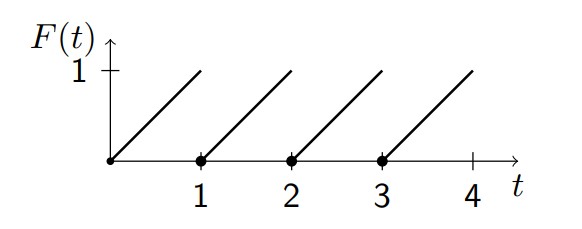
The periodic saw tooth wave satisfies these conditions:

\[f(t) = t, \qquad 0\leq t <1, \qquad f(t+1) = f(t)\]

Periodic sawtooth wave function graph showing F(t) on the vertical axis and t on the horizontal axis. The function consists of repeated linear segments that increase from 0 to 1 over unit intervals. Starting at the origin, the function rises linearly from 0 to 1 as t goes from 0 to 1, then drops back to 0 and repeats this pattern. The pattern shows at t=1, 2, 3, and 4 with filled dots at the base (value 0) of each period. Each linear segment has the same slope, creating a repeating triangular wave pattern. This demonstrates a piecewise continuous periodic function with period T=1.

Laplace Rules:

  1. The Laplace transform is a linear operator: Suppose \(f(t) = C_1 f_1(t) + C_2 f_2(t)\) \[\mathcal{L} \{f(t)\} = C_1\mathcal{L} \{ f_1(t)\} + C_2 \mathcal{L} \{f_2(t)\}\]

  2. If \(f(t) = f_1(t) f_2(t)\) then \(\mathcal{L}\{f(t)\}\) exists.

The Inverse Laplace Transform and Uniqueness

TipExample 5.1.6

Consider the two functions:

\[f_1(t) = e^{-t} \qquad \qquad f_2(t) = \begin{cases} e^{-t} & \text{for } t \notin \mathbb{Z} \\ 0 & \text{for } t \in \mathbb{Z} \end{cases}\]

They both have the same Laplace transform: \(\mathcal{L}\{f_1(t)\}=\mathcal{L}\{f_2(t)\} = \frac{1}{s+1}\)

So if we want to talk about the inverse Laplace transform of \(\frac{1}{s+1}\) we want to know what function has Laplace transform \(\frac{1}{s+1}\). As we can see there can be more than one answer but, unless there is a compelling reason to do otherwise, we will always assume that the inverse Laplace transform is the continuous answer and we would say:

\[\mathcal{L}^{-1}\left\{\frac{1}{s+1}\right\} = e^{-t}\]

Once we know the Laplace transform we can put it in a table. See the text or the end of these notes for an incomplete list of Laplace transform pairs. If you look at row 4 of Table 1 you find that:

\[\mathcal{L}\{e^{\alpha t} \} =\frac{1}{s-\alpha} \qquad \text{and} \qquad \mathcal{L}^{-1}\left\{\frac{1}{s-\alpha }\right\} = e^{\alpha t}\]

TipExample 5.1.7

Find the inverse Laplace transform of:

\[F(s) = \frac{3}{s+2} + \frac{5}{s-2}\]

Solution:

\[\begin{align*} f(t) & = \mathcal{L}^{-1}\{F(s) \}\\ & = \mathcal{L}^{-1}\left\{\frac{3}{s+2}\right\} + \mathcal{L}^{-1}\left\{\frac{5}{s-2}\right\}\\ & = 3\mathcal{L}^{-1}\left\{\frac{1}{s+2}\right\} + 5\mathcal{L}^{-1}\left\{\frac{1}{s-2}\right\}\\ & = 3e^{-2 t} + 5e^{2 t} \end{align*}\]

So \(\boxed{f(t) = 3e^{-2 t} + 5e^{2 t}}\)

5.2 Laplace Transform Pairs

Heaviside Step Functions

The unit step function or Heaviside step function is defined as follows:

\[h(t) = \begin{cases} 1 & t \geq 0\\ 0 & t<0 \end{cases}\]
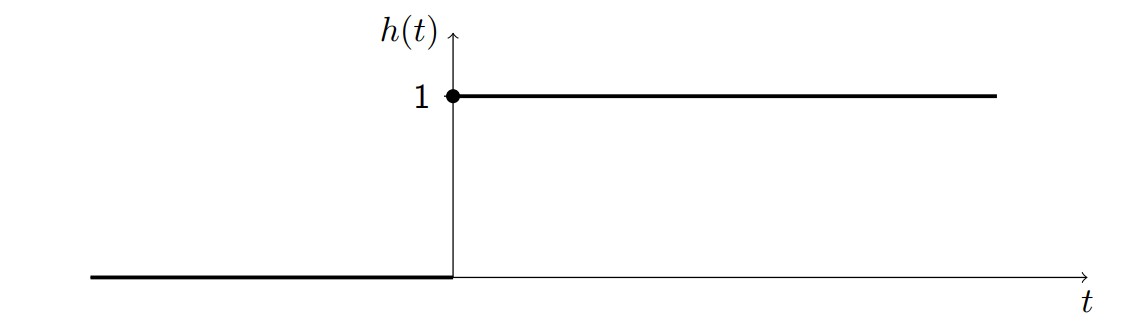
Heaviside step function h(t) graph. The horizontal axis is labeled t and the vertical axis is labeled h(t). For all t < 0, the function has value 0, shown as a horizontal line along the t-axis. At t = 0, there is a vertical jump discontinuity. For all t ≥ 0, the function has constant value 1, shown as a horizontal line at height 1. A filled dot at the point (0,1) indicates that the function value at t=0 is 1. This represents the unit step function that switches from 0 to 1 at the origin.

Shifted by \(\alpha\):

\[h(t-\alpha) = \begin{cases} 1 & t \geq \alpha\\ 0 & t<\alpha \end{cases}\]
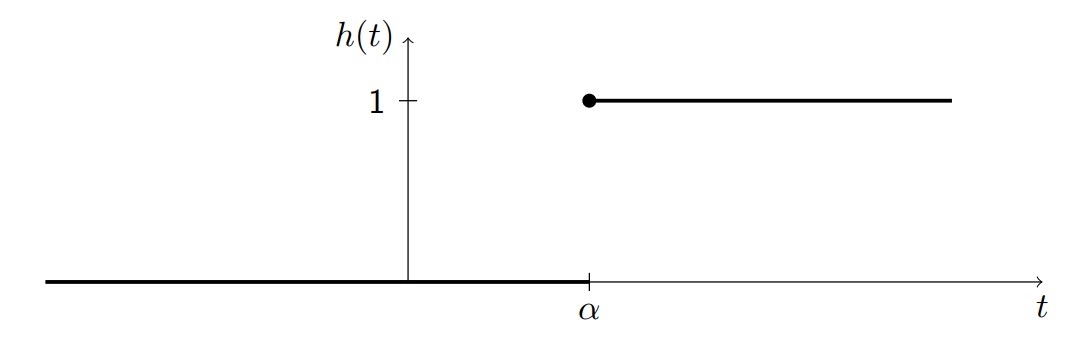
Shifted Heaviside step function h(t-α) graph. The horizontal axis is labeled t and the vertical axis is labeled h(t). For all t < α, the function has value 0, shown as a horizontal line along the t-axis. At t = α, there is a vertical jump discontinuity indicated by a vertical line segment. For all t ≥ α, the function has constant value 1, shown as a horizontal line at height 1. A filled dot at point (α,1) indicates that the function value at t=α is 1. This represents the unit step function delayed by α time units, switching from 0 to 1 at t=α rather than at the origin.

TipExample 5.2.1

Find the Laplace transform of \(h(t)\) and \(h(t-\alpha)\).

Solution:

\[\begin{align*} \mathcal{L}\{h(t)\} &= \int_0^\infty h(t)e^{-st} dt = \int_0^\infty e^{-st} dt = -\frac{1}{s} \left[e^{-st} \right]_0^\infty\\ \mathcal{L}\{h(t)\} &= \frac{1}{s}, \quad s>0 \end{align*}\]

\[\begin{align*} \mathcal{L}\{h(t-\alpha)\} &= \int_0^\infty h(t-\alpha)e^{-st} dt = \int_\alpha^\infty (1)e^{-st} dt = -\frac{1}{s} \left[e^{-st} \right]_\alpha^\infty\\ &= -\frac{1}{s} \left[0 - e^{-\alpha s} \right]\\ \mathcal{L}\{h(t-\alpha)\} &= \frac{1}{s} e^{-\alpha s}, \quad s>\alpha \end{align*}\]

What is \(\mathcal{L}(1)\)?
TipExample 5.2.2

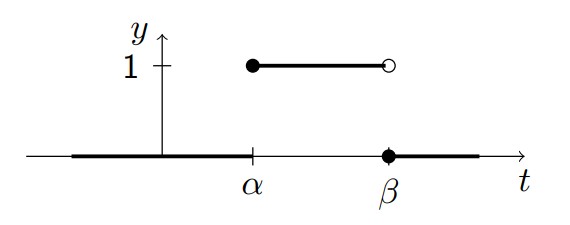
Write the following graph as a single function.

Piecewise step function graph showing y versus t. The function equals 0 for t < α (shown as a horizontal line along the t-axis with a filled dot at the origin). At t = α, there is a jump discontinuity to y = 1 (indicated by a filled dot at (α,1)). The function remains at y = 1 from t = α to t = β (shown as a horizontal line segment). At t = β, there is a jump discontinuity back down to y = 0 (indicated by an open circle at (β,1) and a filled dot at (β,0)). For t > β, the function remains at 0. This represents a rectangular pulse that turns on at t=α and turns off at t=β, which can be expressed as h(t-α) - h(t-β).

TipExample 5.2.3

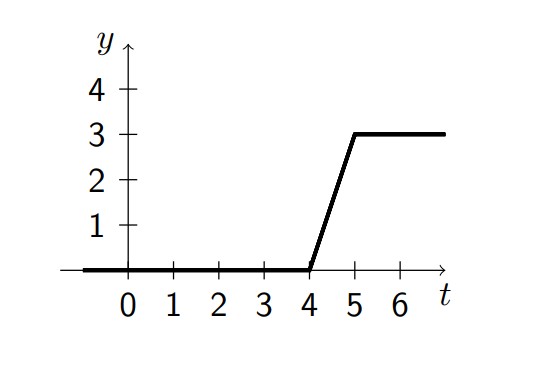
Write the following graph as a single function.

Piecewise linear function graph showing y versus t. The function equals 0 for 0 ≤ t < 4. At t = 4, the function begins increasing linearly, rising from y = 0 to y = 3 over the interval from t = 4 to t = 5 (slope = 3). At t = 5, there is a discontinuity (indicated by a filled dot at (5,3)). For t > 5, the function remains constant at y = 3 (shown as a horizontal line). The horizontal axis shows tick marks at t = 0, 1, 2, 3, 4, 5, and 6. The vertical axis shows tick marks at y = 0, 1, 2, 3, and 4. This piecewise function can be expressed using step functions and represents a delayed ramp that turns on at t=4 and saturates at t=5.

TipExample 5.2.4

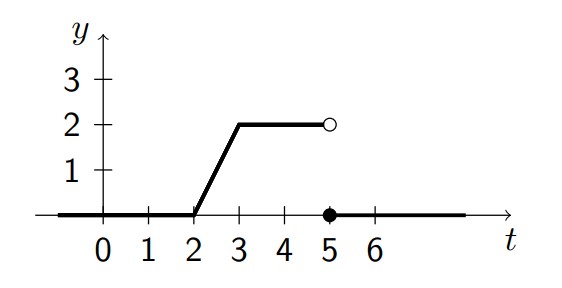
Write the following graph as a single function.

Piecewise linear function graph showing y versus t. The function equals 0 for 0 ≤ t < 2. Starting at t = 2, the function increases linearly from y = 0 to y = 2 over the interval from t = 2 to t = 3 (slope = 2). At t = 3, the function value is y = 2 (indicated by a filled dot). For 3 < t < 5, the function remains constant at y = 2 (horizontal line segment). At t = 5, there is a jump discontinuity down to y = 0 (indicated by an open circle at (5,2) and a filled dot at (5,0)). For t > 5, the function remains at 0. The horizontal axis shows tick marks from 0 to 6. The vertical axis shows tick marks at 0, 1, 2, and 3. This represents a trapezoidal pulse with linear rise starting at t=2, flat top from t=3 to t=5, and instantaneous drop at t=5.

TipExample 5.2.5

Graph the function \(f(t) = \sin(t-2\pi) h(t-2\pi)\)

Laplace Transform Tables

TipExample 5.2.6

Find the Laplace transform of \(f(t) = \sin(3t)\)

TipExample 5.2.7

Find the Laplace transform of \(f(t) = e^{2t}\)

TipExample 5.2.8

Find the Laplace transform of \(f(t) = 3t^2+2t+1\)

Shift Theorems

  1. First Shift Theorem (s-shift): \(\mathcal{L}\{e^{\alpha t} f(t)\} =F(s-\alpha)\)

    where \(\mathcal{L}\{f(t)\} = F(s)\) (See #9 on Table 1)

  2. Second Shift Theorem (t-shift): \(\mathcal{L}\{f(t-\alpha) h(t-\alpha)\} = e^{-\alpha s} F(s)\)

TipExample 5.2.9

Find the Laplace Transform of:

Piecewise step function graph (repeated from Example 5.2.2) showing y versus t. The function equals 0 for t < α, jumps to y = 1 at t = α (with filled dot at (α,1)), remains at 1 for α ≤ t < β, then jumps back to 0 at t = β (with open circle at (β,1) and filled dot at (β,0)). This rectangular pulse function h(t-α) - h(t-β) demonstrates the application of the second shift theorem.

TipExample 5.2.10

Find the Laplace Transform of:

Piecewise linear function graph (repeated from Example 5.2.4) showing y versus t. Zero for t < 2, linear increase from (2,0) to (3,2), constant at y=2 for 3 ≤ t < 5, then drops to 0 at t=5. This trapezoidal pulse demonstrates applying shift theorems to piecewise functions.

TipExample 5.2.11

Find the Laplace transform of \(f(t) = \sin(t-2\pi) h(t-2\pi)\)

TipExample 5.2.12

Find the Laplace transform of \(f(t) = e^{2t} \cos(3t)\)

TipExample 5.2.13

Find the Laplace transform of \(f(t) = e^{4t}(3t^2+2t+1)\)

TipExample 5.2.14

Find the Laplace transform of \(f(t) = e^{3t-3} h(t-1)\)

Inverse Laplace Transforms

TipExample 5.2.15

Find the inverse Laplace transform of \(F(s) = \frac{3}{s} + \frac{24}{s^2}\)

TipExample 5.2.16

Find the inverse Laplace transform of \(F(s) = \frac{2s-4}{(s-2)^2+9}\)

TipExample 5.2.17

Find the inverse Laplace transform of \(F(s) = \frac{4s-6}{s^2-2s+10}\)

Laplace Transforms of Derivatives

  1. \(\mathcal{L}\{ f'(t) \} = s\mathcal{L}\{f(t)\}-f(0) = sF(s) - f(0)\)

  2. \(\mathcal{L}\{ f''(t) \} = s^2F(s) - sf(0) - f'(0)\)

  3. \(\mathcal{L}\left\{ \int_0^t f(u) du \right\} = \frac{\mathcal{L}\{f(t)\}}{s} = \frac{F(s)}{s}\)

TipExample 5.2.18

Find the Laplace transform of the differential equation:

\[\frac{dy}{dt} +6y(t) +9\int_0^t y(\tau) d \tau =1, \qquad y(0)=0\]

and solve for \(Y(s)\). Then use the inverse Laplace transform to find the solution to the equation \(y(t)\).

TipExample 5.2.19

Solve the differential equation:

\[y' +4y = g(t), \qquad y(0)=0\]

where:

\[g(t) = \begin{cases} 0, & 0 \leq t <1\\ 12, & 1 \leq t <3\\ 0, & 3 \leq t <\infty \end{cases}\]

5.3 The Method of Partial Fractions

Type Denominator Partial Fraction
Linear \((s+a)\) \(\frac{A}{s+a}\)
Repeated Linear \((s+a)^n\) \(\frac{A_1}{s+a} + \frac{A_2}{(s+a)^2} + \cdots +\frac{A_n}{(s+a)^n}\)
Quadratic \(s^2+as +b\) \(\frac{A_1 s + A_2}{s^2+as +b}\)
Repeated Quadratic \((s^2+as +b)^2\) \(\frac{A_1 s + A_2}{s^2+as +b}+\frac{A_3 s + A_4}{(s^2+as +b)^2}\)
TipExample 5.3.1

Denominator is a product of distinct linear factors.

\[\frac{3x+7}{x^2+6x+5}\]

TipExample 5.3.2

Denominator is a product of linear factors, some of which are repeated.

\[\frac{3x^2 -8x+13}{(x+3)(x-1)^2}\]

TipExample 5.3.3

Denominator contains irreducible quadratic factors, none of which is repeated.

\[\frac{2x^2+x-8}{x^3+4x}\]

TipExample 5.3.4

Find \(\mathcal{L}^{-1} \left\{ \frac{s^2+4}{s^4-s^2} \right\}\)

TipExample 5.3.5

Find the inverse Laplace transform of:

\[F(s) = \frac{50 s}{(s+1)^2(s^2+4s+13)}\]

Note:

\[\mathcal{L}\left\{e^{\alpha t} t^n \right\} = \frac{n!}{(s-\alpha)^{n+1}}\]

\[\mathcal{L}\left\{e^{\alpha t} \sin \omega t \right\} = \frac{\omega}{(s-\alpha)^2 +\omega^2}\]

\[\mathcal{L}\left\{e^{\alpha t} \cos \omega t \right\} = \frac{s-\alpha}{(s-\alpha)^2 +\omega^2}\]

5.4 Laplace Transforms of Periodic Functions and System Transfer Functions

Periodic Functions
NoteLaplace Transform of a Periodic Function

Definition: Let \(f(t)\) be a piecewise continuous periodic function defined on \(0\leq t < \infty\) with period \(T\). Then the Laplace transform of \(f(t)\) is the function defined by:

\[\mathcal{L}\{f(t)\} =\frac{\int_0^T e^{-st} f(t) dt}{1-e^{-sT}}, \qquad s>0 \tag{5.3}\]

TipExample 5.4.1

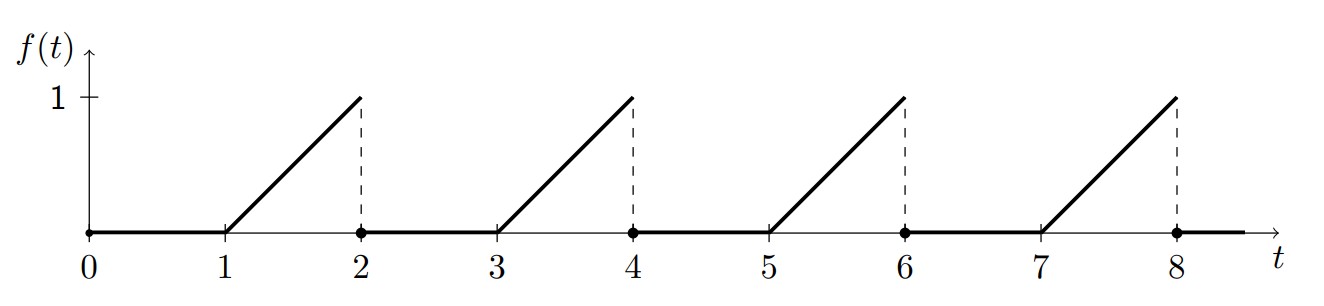
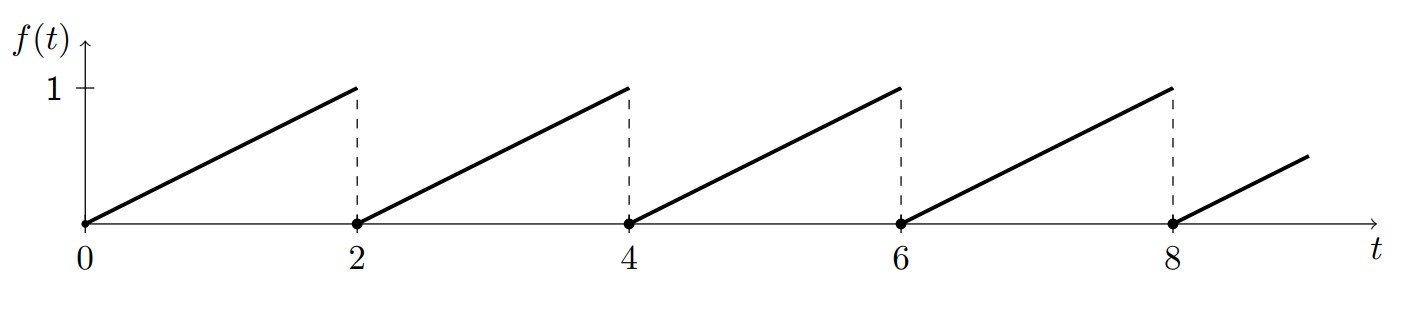
Find the Laplace transform of the function whose graph is shown:

Periodic sawtooth wave function graph showing f(t) on the vertical axis (ranging from 0 to just above 1) and t on the horizontal axis (showing values 0, 2, 4, 6, and 8). The function consists of repeated linear ramp segments. Starting at the origin (0,0), the function increases linearly to reach f(t) = 1 at t = 2 (indicated by a filled dot at (2,1) and vertical dashed line). Then it drops back to 0 and the pattern repeats. The second period shows a linear increase from (2,0) to (4,1) with a dashed vertical line at t=4. The third period goes from (4,0) to (6,1) with dashed line at t=6. The fourth period shows from (6,0) to (8,1) with dashed line at t=8. A fifth period is beginning. Each linear segment has the same slope of 1/2, and the period T = 2. This represents a periodic sawtooth wave with period 2.

TipExample 5.4.2

Find the Laplace transform of the function whose graph is shown:

Periodic triangular wave function graph showing f(t) on the vertical axis (ranging from 0 to just above 1) and t on the horizontal axis (showing values 0 through 8). The function consists of repeated triangular segments. Starting at the origin, the function increases linearly from (0,0) to reach f(t) = 1 at t = 1 (indicated by a filled dot). Then it decreases linearly back to f(t) = 0 at t = 2 (filled dot), with a vertical dashed line at t=2 marking the end of the first period. The pattern repeats with identical triangles: rising from t=2 to t=3 (reaching peak of 1), falling from t=3 to t=4; rising from t=4 to t=5, falling from t=5 to t=6; and so on. Vertical dashed lines at t=4, 6, and 8 mark the completion of subsequent periods. Each triangle has equal slopes (1 going up, -1 going down) and the period T = 2. This represents a periodic triangular wave with period 2.

System Transfer Functions

Consider the spring mass damper system we studied in Chapter 3. Given a mass \(m\), a damper with damping coefficient \(\gamma\) and a spring with spring constant \(k\) then the system from equilibrium can be modeled by the differential equation:

\[my''+\gamma y' +ky =f(t), \quad t\geq 0, \qquad y(0)=0, \quad y'(0) = 0\]

where \(f(t)\) is some external force.

We can solve this using the techniques from chapter 3 or we can solve it using Laplace transforms by using:

\(\mathcal{L}\{ g'(t) \} = sG(s) -g(0)\)

\(\mathcal{L}\{ g''(t) \} = s^2G(s) -sg(0)-g'(0)\)

\[\begin{align*} \mathcal{L}\{my''+\gamma y' +ky \} &= \mathcal{L}\{f(t) \}\\ m(s^2Y(s)) + \gamma (sY(s)) +kY(s) &= F(s)\\ Y(s) &= \frac{1}{ms^2 + \gamma s + k} F(s) \end{align*}\]

We can think of \(\dfrac{1}{ms^2 + \gamma s + k}\) as a single item and call it \(\Phi(s) = \dfrac{1}{ms^2 + \gamma s + k}\). Then our equation in the transform domain is simply:

\[Y(s) = \Phi(s) F(s)\]

where \(\Phi(s)\) can be found from knowing the input \(F(s)\) and the output \(Y(s)\) and nothing else.

\[\Phi(s) = \frac{Y(s)}{F(s)} \tag{5.4}\]

\(\Phi(s)\) is called the system transfer function.
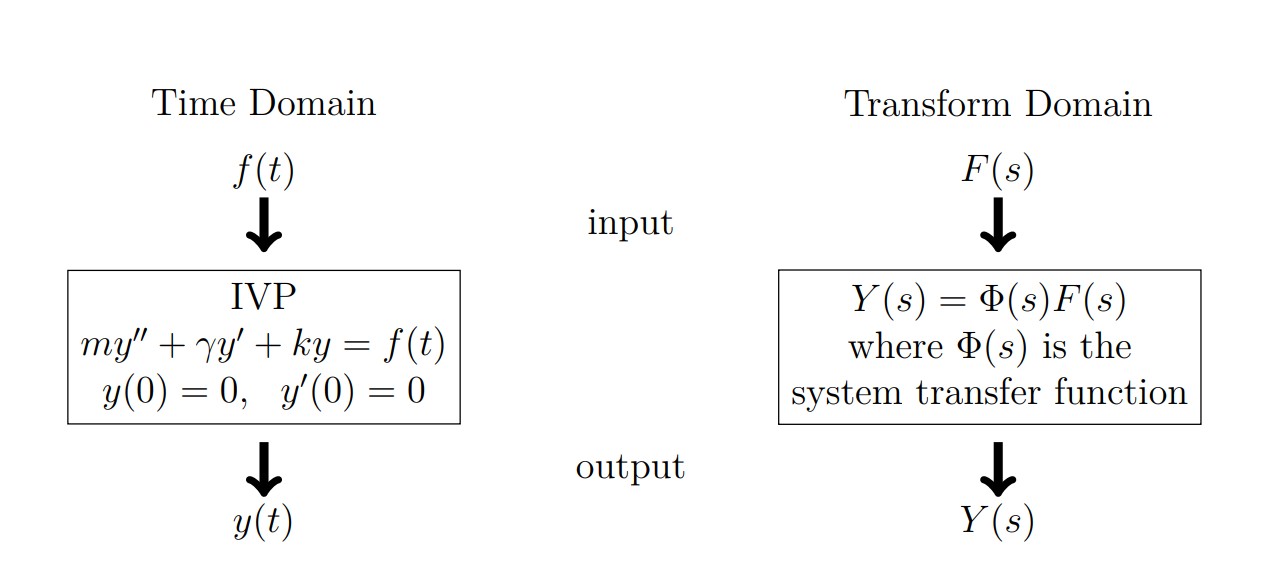
System transfer function diagram comparing time domain and transform domain approaches. The diagram is divided into two columns. Left column labeled Time Domain shows: at top, input function f(t) with downward arrow; middle box contains IVP: my″ + γy′ + ky = f(t), y(0) = 0, y′(0) = 0; bottom shows output y(t) with downward arrow; text input and output label the arrows. Right column labeled Transform Domain shows: at top, F(s) with downward arrow; middle box contains Y(s) = Φ(s)F(s) where Φ(s) is the system transfer function; bottom shows Y(s) with downward arrow. The columns are connected by horizontal blue arrows: top arrow labeled Laplace Transform points right, bottom arrow labeled Inverse Laplace Transform points left. This illustrates that the complex differential equation in time domain becomes simple multiplication in transform domain, where Φ(s) = 1/(ms² + γs + k) is the system transfer function characterizing the system independently of the specific input.

Figure 5.1: Two ways to solve a mechanical system. In the time domain or the Laplace domain.

TipExample 5.4.3

Suppose we know we have the spring-mass-damper system:

\[my''+\gamma y' +ky=f(t), \quad y(0)=0, \quad y'(0) = 0\]

If we apply the Heaviside step function as the input forcing function \(f(t) = h(t)\) then the output is:

\[y(t) = \frac{1}{2} -\frac{1}{2}e^{-t}\cos t - \frac{1}{2}e^{-t}\sin t\]

Given a new input of \(\hat{f}(t) = e^{-2t}\), what is the new output \(\hat{y}(t)\)?

5.6 Convolution

Recall: In Section 5.4 we looked at system transfer functions as a way of predicting behavior. The system transfer function for a known input \(f(t)\) and known output \(y(t)\) is given by:

\[\Phi(s) = \frac{Y(s)}{F(s)}\]

We used this function to answer the question, “what is the new output \(\hat{y}(t)\) for some new input \(\hat{f}(t)\)?”

\[\hat{Y}(s) = \Phi(s) \hat{F}(s)\]

so the solution requires us to inverse Laplace transform a product:

\[\hat{y}(t) = \mathcal{L}^{-1} \{\hat{Y}(s) \}=\mathcal{L}^{-1} \{ \Phi(s) \hat{F}(s) \}\]

To solve this problem without needing to compute the inverse Laplace transform we have the convolution integral:

NoteConvolution Integral

Definition: Let \(f(t)\) and \(g(t)\) be two functions with Laplace transforms \(F(s)\) and \(G(s)\). The convolution integral is:

\[(f * g)(t) = \int_0^t f(t-\lambda) g(\lambda) d\lambda \tag{5.5}\]

\[(f * g)(t) = \mathcal{L}^{-1}\{F(s)G(s)\} \tag{5.6}\]

TipExample 5.6.1

Solve the convolution two ways. Use the integral (equation 5.5) and the inverse Laplace transform (equation 5.6).

\[e^{3t} * e^{-t} = \int_0^t e^{3(t-\lambda)} e^{-\lambda} d\lambda\]

and

\[e^{3t} * e^{-t} = \mathcal{L}^{-1}\left\{\mathcal{L}\{e^{3t}\} \mathcal{L}\{e^{-t}\}\right\}= \mathcal{L}^{-1}\left\{\left(\frac{1}{s-3}\right)\left(\frac{1}{s+1}\right)\right\}\]

TipExample 5.6.2

\[t * \cos(5t)\]

TipExample 5.6.3

A spring/mass/damper system has mass 1 kg, damping constant 8 kg/sec and spring constant 12 kg per sq sec. The system starts at rest and then has an external force of \(f(t) = e^{-4t}\) Newtons applied after \(t\) seconds. The IVP below models the system:

\[x''+8x'+12x = e^{-4t}, \quad x(0)=0, \quad x'(0)=0\]

The Laplace transform of the IVP has solution \(X(s) = F(s) \Phi(s)\) where \(F(s) = \mathcal{L}\{e^{-4t}\}\) and:

\[\Phi(s) = \frac{1}{s^2+8s+12} = \frac{1}{(s+6)(s+2)}\]

represents the system transfer function. The weight function \(w(t)\) is the inverse Laplace transform of the transfer function.

\[w(t) = \mathcal{L}^{-1}\{\Phi(s)\} = \mathcal{L}^{-1}\left\{\frac{1}{(s+6)(s+2)}\right\}\]

The solution to the IVP is the convolution of the forcing term with the weight function.

\[y(t) = f(t)*w(t)\]

Find the solution \(y(t)\).

5.7 The Delta Function and Impulse Response

We will define the delta function \(\delta(t)\) to be the function with the following property:

\[\int_a^a \delta(t) dt = 1\]

We can do this by using the impulse function:

\[P_{\epsilon}(t) = \begin{cases} \frac{1}{\epsilon}, & 0 \leq t <\epsilon\\ 0, & \epsilon \leq t <\infty \end{cases}\]

drawn below.
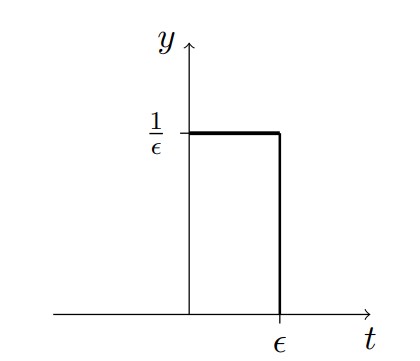
Impulse function graph showing y versus t. The function has value 1/ε (labeled on the y-axis) for the interval 0 ≤ t < ε, shown as a horizontal line segment at height 1/ε. The interval width is marked as ε on the t-axis. At t = ε, there is a vertical line segment dropping down to y = 0, and the function equals 0 for all t ≥ ε. The graph illustrates a rectangular pulse of width ε and height 1/ε, so the area under the curve is (1/ε)·ε = 1 regardless of the value of ε. As ε approaches 0, this function approaches the Dirac delta function: infinitely tall, infinitesimally narrow, but always with unit area.

We can think of the delta function as the limit of the impulse function: \(\delta(t) = \lim_{\epsilon \rightarrow 0} P_{\epsilon}(t)\). This is not the formal definition but it is close enough to get an idea of what is happening. The Laplace transform of the delta function (row #27 in Table 1) is:

\[\mathcal{L}\{\delta(t-\alpha) \} = e^{-\alpha s}\]

TipExample 5.7.1

Solve \(y''+2y' +2y = \delta(t-1)\), \(y(0)=0\), \(y'(0)=0\).

(ans. \(y(t) = e^{-(t-1)}\sin(t-1)h(t-1)\))